One of the most common questions B2B companies ask before investing in demand generation is, “How long will it take to see results?”
It is a fair question. You are investing in content, outreach, research, campaigns, sales resources, and technology, so you want to know when those efforts will start contributing to your pipeline.
The challenge is that B2B demand generation does not usually work overnight. A prospect might discover your company today, engage with your content next month, respond to an outreach message later, and only become ready to buy when a specific business need appears.
That is why demand generation should be treated as a long-term system for creating and capturing demand, not a short-term campaign designed to produce instant leads.
There is no universal timeline for every B2B company. However, understanding what happens at different stages can help you set realistic expectations and measure progress properly.
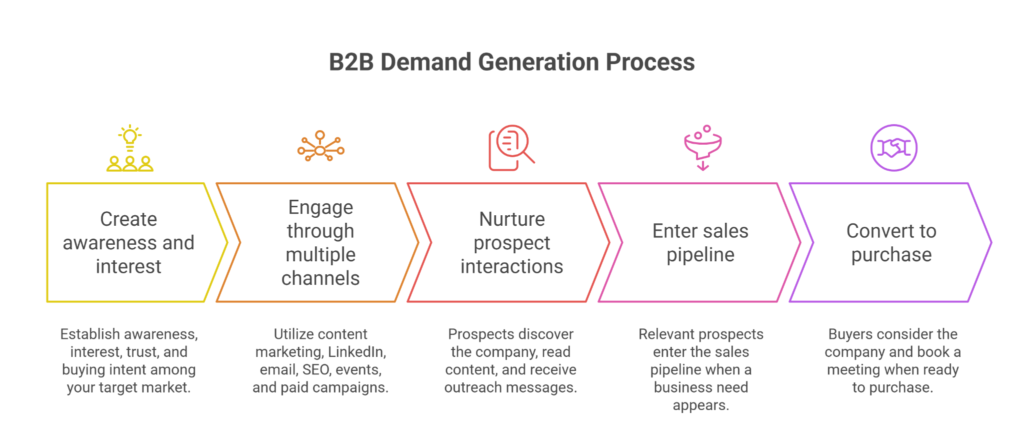
B2B demand generation is the process of creating awareness, interest, trust, and buying intent among your target market so that relevant prospects eventually enter your sales pipeline.
It goes beyond simply collecting leads.
A strong demand generation strategy helps potential buyers understand their problems, recognise the impact of those problems, discover possible solutions, and consider your company when they are ready to make a purchase.
This can include content marketing, LinkedIn marketing, email outreach, SEO, events, paid campaigns, thought leadership, sales enablement, prospecting, and other activities.
The important part is that these activities work together.
A prospect may discover your company through a LinkedIn post, read your website, receive an email from your sales team, see a case study, and eventually book a meeting. Every one of these interactions can contribute to the demand generation process.
There is no fixed number of days or months that guarantees results.
In many B2B businesses, early engagement and conversations can appear within the first few weeks, while meaningful and repeatable pipeline results often take several months to develop.
The timeline depends on several factors, including your target market, offer, sales cycle, average deal size, existing brand awareness, competition, marketing channels, budget, and consistency.
A company selling a straightforward service to a clearly defined market may generate conversations relatively quickly.
A company selling complex enterprise software may need months of education, multiple stakeholder interactions, technical evaluation, procurement, and internal approval before a prospect becomes a customer.
So instead of asking only, “When will we get customers?”, it is more useful to understand what should happen throughout the demand generation journey.
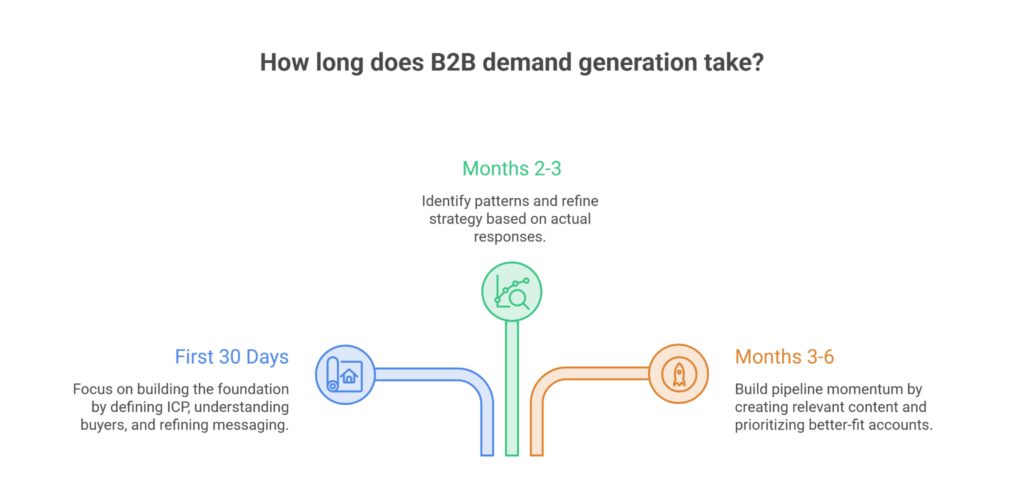
The first month is usually about building the foundation.
Before increasing outreach or spending heavily on campaigns, you need clarity about who you are targeting and why they should care about your solution.
This means defining your ideal customer profile, understanding your buyers, identifying decision-makers, researching their problems, studying competitors, refining your positioning, and developing relevant messaging.
Your team may begin generating engagement and conversations during this period, but the most important outcome is often learning.
You start discovering which industries respond, which job roles engage, which messages attract attention, and which problems create interest.
Without this foundation, increasing activity can simply create more noise.
Once your strategy is running consistently, you can begin identifying patterns.
You may discover that certain industries respond more strongly than others. A particular decision-maker may be more engaged. One problem statement may generate more replies than another. A specific content topic may result in more conversations.
This is where demand generation becomes more valuable.
Instead of guessing what your market wants, you can start making decisions based on actual responses.
Your team can refine its messaging, improve targeting, adjust outreach, create more relevant content, and focus on channels producing stronger signals.
The objective at this stage is not simply to generate more activity.
It is to understand what creates meaningful engagement with the right prospects.
Many B2B companies make the mistake of judging demand generation too early.
They launch a campaign, wait a few weeks, see that significant revenue has not appeared, and conclude that the strategy is not working.
But demand generation often requires experimentation before you find the right combination of audience, message, offer, channel, and timing.
The early months should therefore be treated as a period of testing, learning, and optimisation, rather than simply a race for immediate revenue.
After several months of consistent execution, you should have much more information about your market and campaigns.
You know more about your ICP. You have a better understanding of the problems that create conversations. You have data about which channels generate responses. You know which messages are being ignored and which ones create interest.
You also start understanding the objections that repeatedly appear during sales conversations.
This allows you to improve the entire system.
Your marketing team can create more relevant content. Your sales team can prioritise better-fit accounts. Your outreach can become more contextual. Your follow-up can become more structured.
The objective now changes from “Can we generate interest?” to “Can we consistently generate qualified opportunities?”
That is a much more meaningful measure of demand generation.
A prospect may be interested in your solution but not ready to buy.
They may have a problem but no budget. They may have budget but no immediate urgency. They may be comparing several vendors. They may need leadership approval. They may already be working with another provider.
This means the first interaction may not produce an immediate sales opportunity.
The objective is to remain relevant until the prospect reaches a point where a buying conversation makes sense.
B2B purchasing decisions are often more complicated than consumer purchases.
The person who discovers your solution may not be the person who approves it.
A user may identify the problem. A manager may evaluate the solution. A technical team may assess implementation. Finance may review the commercial terms, while leadership makes the final decision.
This creates a longer buying journey and makes consistent communication important.
For many B2B products and services, prospects need evidence before they are comfortable moving forward.
They may review your website, LinkedIn presence, case studies, customer stories, reviews, content, expertise, and conversations with your team before deciding.
That is why demand generation is not simply about getting your brand in front of more people.
It is about giving the right prospects enough reasons to believe that your company understands their problems and can help solve them.
Demand generation and lead generation are often used interchangeably, but they are not the same.
Lead generation focuses primarily on identifying and capturing potential prospects.
Demand generation goes further by creating awareness, educating the market, building trust, creating preference, and encouraging future buying conversations.
You can generate thousands of contacts through a database, but if those contacts do not have a relevant problem, do not understand your value, or have no reason to speak with you, the database will not automatically create demand.
The goal is to connect the right audience with the right message at the right time.
The broader your target market, the harder it becomes to create relevant messaging.
A clearly defined ICP helps you focus on specific industries, company sizes, business situations, roles, challenges, and buying signals.
Instead of asking, “Who can buy from us?”, ask, “Which companies have the strongest reason to consider our solution?”
Your audience needs a reason to engage.
A generic message such as “We provide innovative business solutions” gives prospects very little reason to respond.
A specific offer connected to a recognisable business problem is easier to understand and evaluate.
The clearer the problem and expected outcome, the easier it becomes for the prospect to decide whether a conversation is relevant.
Demand generation requires repeated exposure.
A prospect may not respond to your first post or email, but continued exposure to useful content can gradually build familiarity and trust.
Your content should answer questions your buyers are already asking and demonstrate that your company understands their problems.
Not every prospect that fits your ICP is ready to talk.
Business changes can provide useful context.
Hiring, expansion, funding, new leadership, product launches, market entry, and technology changes can indicate that something has changed inside an account.
Combining ICP fit with relevant signals can make prospecting more focused and timely.
Demand generation should not remain static.
Review response quality, qualified conversations, objections, content engagement, account quality, conversion rates, and sales outcomes regularly.
Then use those insights to improve the next campaign.
The faster you learn, the faster you can improve the system.
To get valuable free insights deliver straight to your inbox
As an entrepreneur, I have gained great exposure to B2B sales strategies, processes, and practices as CEO of Salesamore. I am known for a strict approach and do not deviate from my target, which is to get my sales figures up by means of lead generation, demand generation, and Account-Based Marketing (ABM).
Through the deep understanding of Go-To-Market (GTM) strategies, I have been branded by the corporate sector as the one who turns opportunities into reality and the one who brings magic to the whole process.
I am thrilled to help startups polish their sales methods and smash the competition with unprecedented results. We hope you enjoyed reading this blog!
Don’t forget to check out these valuable resources to stay connected and explore more about what we have to offer:
Subscribe to My YouTube Channel: Stay updated with the latest videos, tutorials, and insights by subscribing to our YouTube channel.
Visit Our Website: Learn more about our services, solutions, and how we can help you achieve your goals by visiting our official website.
Watch Our Featured Video (VSL): Don’t miss our featured video! Click here to watch and gain valuable insights.
In accordance with the current EU data protection laws, please take a minute to reviwe the term & conditions for using our services. Our terms describe how we use data and the options available to you.

