Automated systems are providing B2B sales teams with new methods for finding prospects, researching companies, writing outreach messages, managing follow-ups, and tracking their pipeline.
However, here is where companies are falling into a trap.
Instead, they’re just putting AI tools into the sales process without enhancing the process itself.
They could have an AI write emails, generate prospect lists, summarise meetings, and update CRM records, and it may even be more effective than what a human can do. But if they haven’t fixed their process, they’re just AI-ing their inefficiency.
But that isn’t the true utility of AI.
An intelligent B2B sales process driven by AI ought to assist your salespeople in making smarter decisions, cutting down on monotonous tasks, focusing on high-priority opportunities, and freeing salespeople to have more in-depth conversations with potential clients.
Which areas of our sales process could AI optimise?
What is an AI-Driven B2B Sales Process? It is an AI-driven solution that merges the human-based sales process with an AI solution into research, prospecting, lead scoring, personalisation, follow-up, and reporting.
The salesperson has not given up the “relationship, strategy, judgment, and the big talk.”
All AI does is enable them to analyse more data, see trends more quickly, and redirect their time to where it is most needed.
Here’s an example of how an AI-powered sales process might be as simple as:
Define
Learn about the client. Gather the most common terms for your account; find out where they originated and who owns the account. Use your company email to look for key contacts in the organisation.
Search for current events and findings on your account.
The more you understand, the better.
Find Companies
Search the business and executive directories. Discover who is writing about your account in the press and what they’re saying. Keep up with your account by setting up Google alerts.
Research
Identify the common topics, keywords and phrases associated with the account.
Research the industry. Identify the decision-maker, the people and groups most influential. Know the pain points, key challenges and hot-button issues.
Identify Signals
Find out what is happening at your account, both internally and externally. Sources like Newslink can help you get there.
Prioritize
Know your lists and priorities.
Learn about the companies and the issues facing them.
Personalize
Think about the questions you have, the next questions to ask and the things you need to learn.
Reach Out
Custom-make a call, email and presentation. Remember, no gimmicks and no pitches….
What matters is that the AI assists throughout the process. This should not be reduced to a mere tool for firing off sales emails.
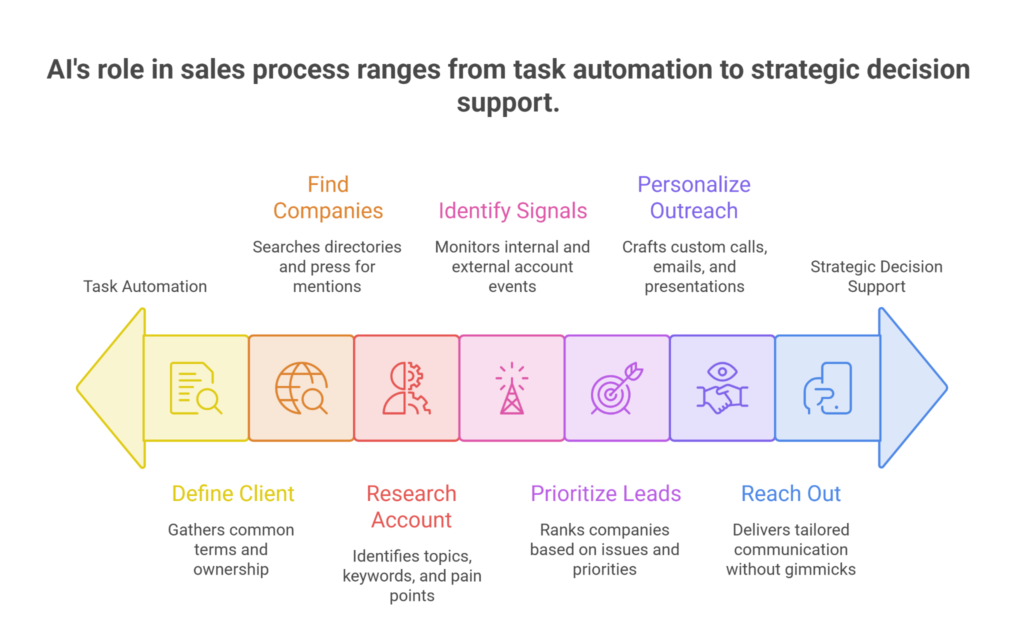
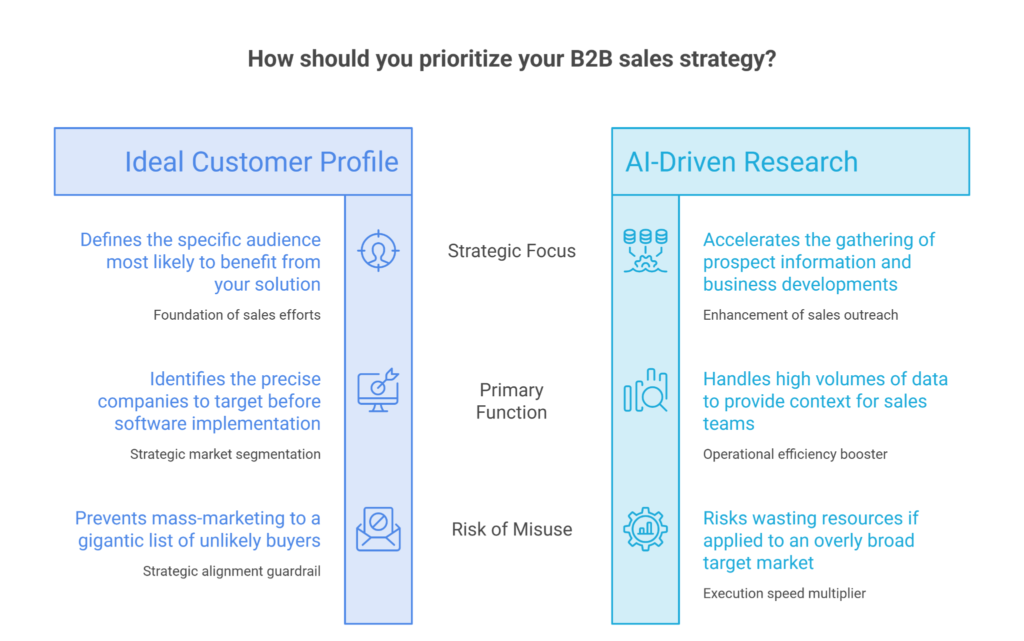
Figure out who you really want to sell to before you start throwing AI into the mix.
Your ICP cannot be as broad as “We sell to SaaS companies” or even “We sell to mid-sized companies.”
AI is capable of handling a high volume of data, but it is not capable of saving a defined target market.
The company will mass-market you to a gigantic list of companies that will likely never buy from you if your ICP is too broad.
The aim is not to get bigger companies.
The objective is to identify the companies most likely to benefit from your solution.
One of the areas where AI will have an impact is research.
Rather than having your salespeople spend time on the road, visiting websites, reading the About Us pages and LinkedIn profiles, and then gathering this information manually, AI can do it all in a fraction of the time.
For instance, prior to contacting a prospect, your sales team may want to search for:
This provides more information to your salesperson than just the company name and a job title.
It Gives Them Context.
It is not a matter of just capturing additional data.
It is connecting the dots.
Let’s say a company is recruiting heavily in its finance team – perhaps they are scaling up. Another is expanding into new markets – perhaps they are introducing new systems or processes. Another has just onboarded a new technology leader – perhaps they are evaluating their current technology landscape.
None of these indicators will guarantee that the company has a buying need.
“This is a worthwhile account to examine more closely.”
That is where research becomes sales intelligence.
One of the biggest challenges with traditional prospecting is that every lead can be viewed as all the same.
AI can help your team prioritise them.
For example, you might correlate ICP fit, company profile, buying signals, degree of previous engagement, job role, tech stack and other variables to identify who to prioritise.
“How many prospects can we contact today?”
“Which production prospects are worth calling today and why?”
Much more use we can make of the sale.
Your team may not even have to reach out to more individuals.
It requires investing more with the.
AI can help sales personalisation get a lot easier, but personalisation should be so much more than inserting a prospect’s first or last name or a company name into a template.
Real personalisation begins with knowing why your message should matter to this particular prospect.
How to use AI as a sales tool: AI can assist salespeople in summarising their company research, identifying key discussion points, getting context on the customer, and recommending ways to organise the message.
But the end message still needs to sound like something the average salesperson would send.
That distinction matters.
Your prospect does not care that you build AI into the message.
They want to know if it is relevant to their business.
It is not there to take away the role of a salesperson.
The objective is to equip the salesperson with more knowledge so that they can initiate improved discussions.
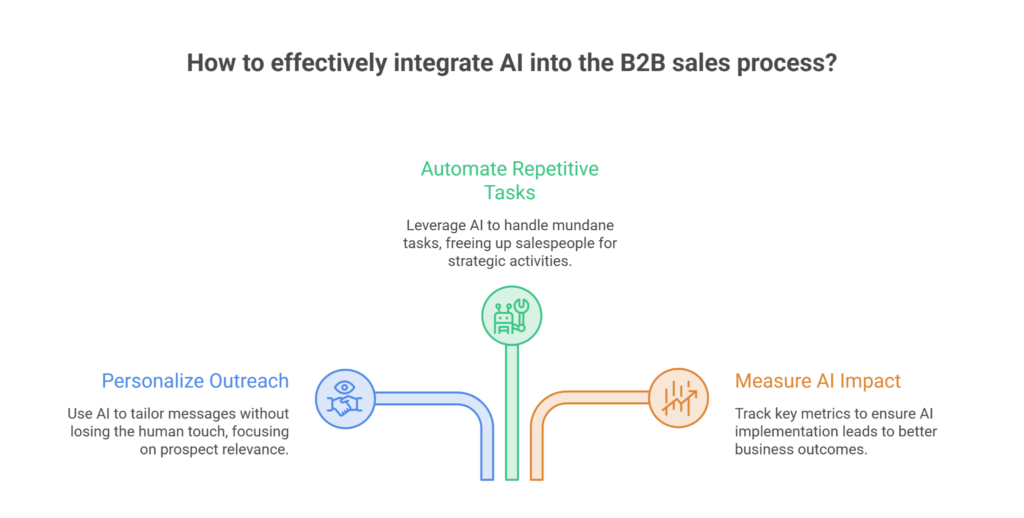
Not every sales task is worthy of your salespeople’s time.
Repetitive tasks that could easily be (and mostly are) automated or assisted by AI:
Automate the boring work. Help with the hard work. Humans must always remain in the driving seat of the relationship.
There are still things that only the human ear can hear, such as discovery conversations, negotiations, relationship building, strategic decisions and the bigger business issues your customer faces.
AI should free up your salespeople to do those activities, not occupy them.
Making your sales process smarter with AI doesn’t mean the sales process will be better.
You still have to measure whether it’s making business outcomes better.
Let’s say a pilot strategy using AI enables your team to send 5,000 emails rather than 2,000, but the number of qualified conversations is unaffected. Did you just accelerate your sales process?
You have simply increased activity.
That difference is important.
More activity doesn’t necessarily equal more sales.
The real goal is better targeting, better conversations, better opportunities, and ultimately better revenue.
Artificial intelligence will keep changing how B2B sales teams work, but the best companies will not just replace everything with automation.
They will create systems where technology handles the tasks that involve a lot of data and repetition,n while salespeople focus on understanding customers, building trust, solving problems and pushing decisions forward.
That is what makes a sales process that uses intelligence for B2B sales useful.
It is not about having the most AI tools.
It is about creating a better sales system.
At Salesamore, we help B2B companies create ways to find customers through Ideal Customer Profile targeting, researching prospects using LinkedIn, writing email messages, qualifying leads, following up and using AI in workflows.
Want to build a B2B sales process?
Comment “SALES”. Send a message with “SALES” and let’s start a conversation.
Schedule a call with Salesamore to talk about your current sales process, your sales pipeline and your customer acquisition issues.
To get valuable free insights deliver straight to your inbox
As an entrepreneur, I have gained great exposure to B2B sales strategies, processes, and practices as CEO of Salesamore. I am known for a strict approach and do not deviate from my target, which is to get my sales figures up by means of lead generation, demand generation, and Account-Based Marketing (ABM).
Through the deep understanding of Go-To-Market (GTM) strategies, I have been branded by the corporate sector as the one who turns opportunities into reality and the one who brings magic to the whole process.
I am thrilled to help startups polish their sales methods and smash the competition with unprecedented results. We hope you enjoyed reading this blog!
Don’t forget to check out these valuable resources to stay connected and explore more about what we have to offer:
Subscribe to My YouTube Channel: Stay updated with the latest videos, tutorials, and insights by subscribing to our YouTube channel.
Visit Our Website: Learn more about our services, solutions, and how we can help you achieve your goals by visiting our official website.
Watch Our Featured Video (VSL): Don’t miss our featured video! Click here to watch and gain valuable insights.
In accordance with the current EU data protection laws, please take a minute to reviwe the term & conditions for using our services. Our terms describe how we use data and the options available to you.

