A great product does not guarantee you business.
You can have the product, experienced salespeople, a solid marketing team, and a competitive price, and still struggle to bring in revenue month after month.
Why?
Because having something to sell is only part of the picture. You also need to know who you are selling to, what you will say to them, how you will reach them, and how you will turn interest into paying customers.
That plan is your go-to-market strategy, or GTM for short.
For B2B companies, a clear GTM strategy gets marketing, sales, product, and leadership pointing at the same revenue goal instead of pulling in different directions. Here is how it works.
A go-to-market strategy is your plan for taking a product or service into a specific market and turning potential buyers into customers.
It answers a handful of questions: Who are we selling to? What problem are we solving for them? Why should they pick us? How will we reach them? And how will we convert them?
A GTM strategy is not a marketing plan or a sales plan. It is the thing that connects the two.
Say a company sells cybersecurity services. A weak version of their pitch sounds like this:
“We provide cybersecurity services to businesses.”
A go-to-market strategy makes it specific:
“We help mid-sized healthcare companies find and fix security gaps before they turn into compliance or operational problems.”
Now there is an audience, a problem, a message, and a reason to talk. That is the difference.
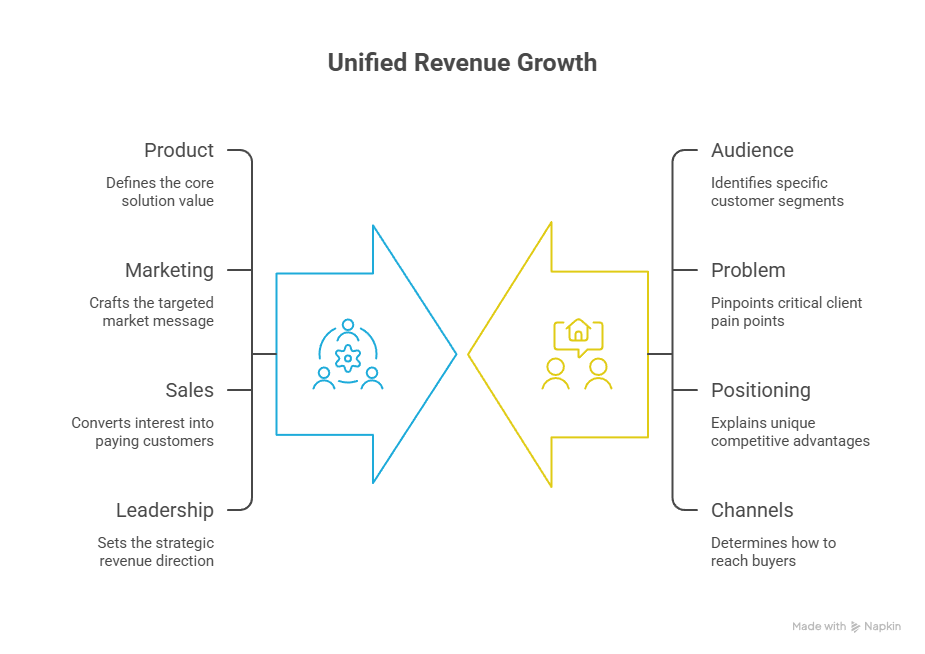
B2B buying is messy. You are usually dealing with multiple decision makers, long sales cycles, competing priorities, budget constraints, procurement, and a few competitors circling the same deal.
Without a GTM strategy, teams drift apart. Marketing hands over leads sales does not want. Sales chases companies that were never a good fit. Product builds features buyers do not care about. And leadership expects revenue without a clear way of acquiring it.
A go-to-market strategy pulls those pieces back together. Everyone knows where the company is headed and how it plans to get there.
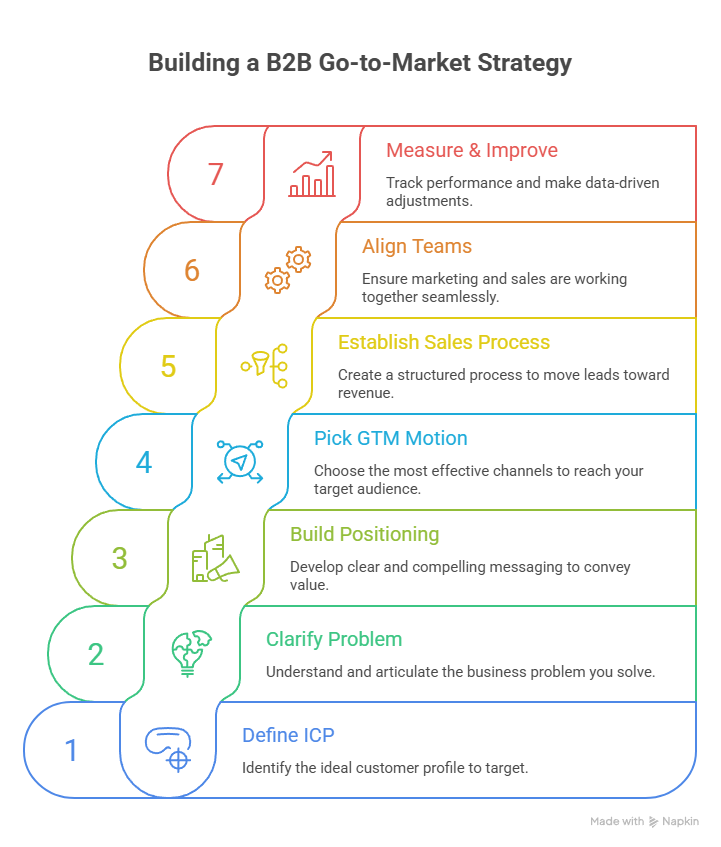
The first question is not “how do we get more leads?” It is “which companies are actually likely to buy from us?”
Your ideal customer profile (ICP) describes the kind of company you want to go after. It usually covers things like industry, company size, revenue, location, the technology they already use, their business model, their growth stage, the challenges they are facing, and the events that trigger a purchase.
Instead of aiming at “technology companies,” your ICP might look like this:
“US-based B2B SaaS companies with 50 to 250 employees, growing fast and running into engineering capacity limits.”
That gives sales and marketing a real target instead of a vague one.
2. Get clear on the problem you solve
Build your strategy around a business problem, not a product feature.
Do not start with “we offer AI.” Start with “what does our AI actually fix?”
Buyers do not wake up wanting another platform. They want to cut costs, bring in more revenue, save time, work more efficiently, or lower their risk. The better you understand the problem, the sharper your positioning gets.
Once you know who you are targeting and what problem you are solving, you have to explain your value in a way people get.
Good messaging answers four things: who you help, what problem you solve, how your approach is different, and what result the customer can expect.
Compare these two. First:
“We provide digital transformation services.”
Now:
“We help manufacturers replace spreadsheets and manual processes with connected systems, so leadership finally has real-time visibility.”
The second one gives the buyer something concrete to react to.
No single GTM model fits every B2B company. Depending on your market, you might lean on outbound sales, inbound marketing, account-based marketing, product-led growth, partner sales, founder-led sales, events, or social selling on LinkedIn.
Most companies end up using a mix. What matters is choosing channels based on where your buyers actually spend their time and how they like to buy, not on what is trendy.
Generating interest is just the start. You need a process that moves that interest toward revenue.
A typical B2B sales process runs through prospecting, qualification, discovery, solution, proposal, negotiation, and close. Each stage needs a clear objective and a next action.
Qualification, for instance, is where you figure out whether the prospect really has the problem, the authority to buy, the urgency to act, and the budget to move forward.
Without a defined process, results ride entirely on individual salespeople. With one, you can measure it, improve it, and scale it.
The classic GTM breakdown happens right in the gap between these two teams.
Marketing says, “We generated 500 leads.” Sales says, “None of them was any good.”
A strong strategy fixes this by getting both sides to agree on the basics: the ICP, the target accounts, the messaging, what counts as a qualified lead, the sales stages, the pipeline targets, and the revenue goals.
When both teams work from the same plan, the whole revenue engine runs smoother.
A GTM strategy is not something you write once and file away. You have to track what is working.
Useful metrics include lead-to-opportunity conversion, opportunity-to-customer conversion, customer acquisition cost, sales cycle length, pipeline value, win rate, revenue by channel, and average deal size.
If a channel brings in tons of leads but almost no customers, dig into why. If another brings in fewer leads but far more revenue, that is probably where more of your budget should go. Let the numbers guide the calls.
People mix these up all the time.
A sales strategy is mostly about how your sales team acquires and closes customers. A go-to-market strategy is wider. It covers the market, the ICP, positioning, messaging, marketing, sales, channels, and how you acquire customers overall.
Think of the GTM strategy as the whole map. Your sales strategy is one route on it.
B2B companies without a clear GTM strategy tend to hit the same wall. Sales targets too many different types of companies. Marketing produces content with no particular buyer in mind. Lead generation turns into a volume game. Sales cycles get unpredictable. Teams fumble when asked to explain their value, and good opportunities slip through. Acquiring customers gets expensive.
The real cost is predictability. You might still land customers. You just will not have a repeatable way to land more of them.
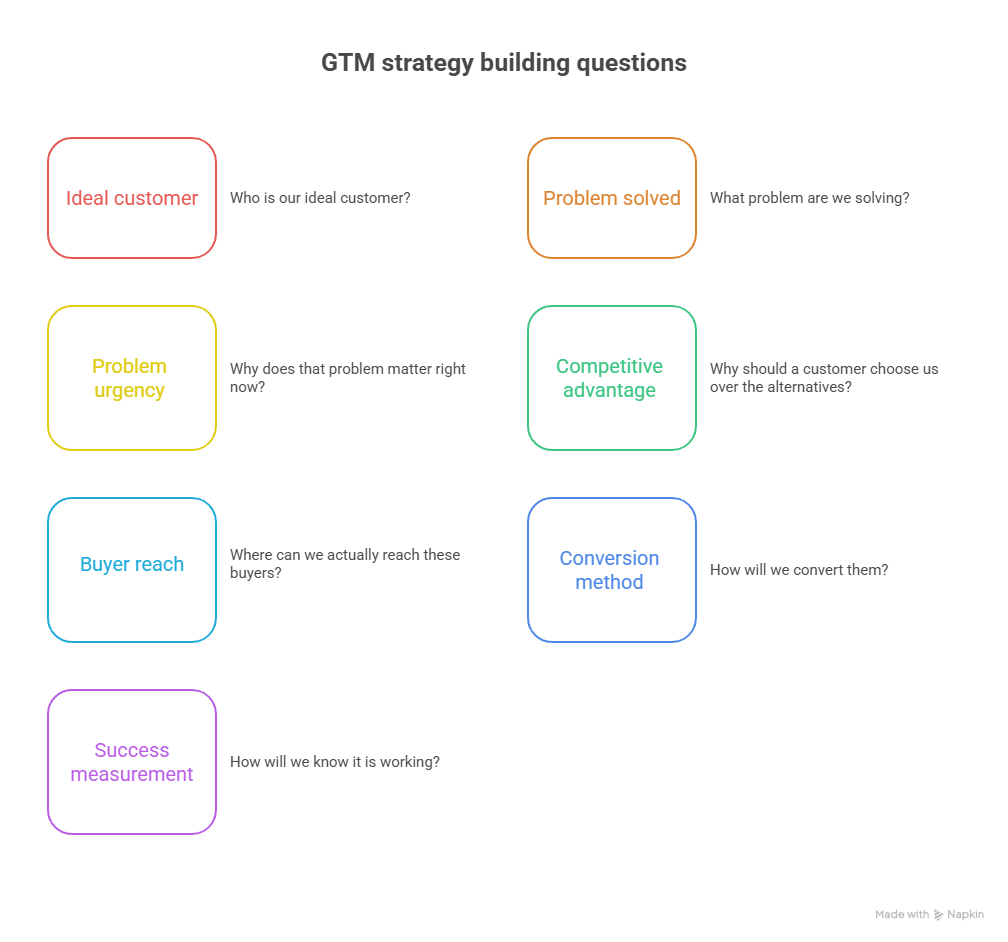
You do not need a hundred-page document. Start with seven questions: Who is our ideal customer? What problem are we solving? Why does that problem matter right now? Why should a customer choose us over the alternatives? Where can we actually reach these buyers? How will we convert them? And how will we know it is working?
If your team can answer those clearly, you have the foundation of a go-to-market strategy.
A go-to-market strategy is not really about launching a product. It is about building a path from a market opportunity to revenue you can count on.
Done right, it helps you identify the customers worth chasing, explain your value in plain terms, pick the channels that fit, and run a sales process that holds up as you grow. When your GTM strategy and your sales process line up, your team stops chasing random deals and starts focusing on the buyers most likely to say yes.
You do not necessarily need more leads. You need a system for finding, engaging, qualifying, and converting the right ones.
At Salesamore, we help B2B companies build sales and client acquisition systems around their ideal customer profile, positioning, prospecting, outreach, qualification, and sales process.
If you are generating leads but struggling to turn them into revenue, book a free strategy call with us. We will find the gaps in your current go-to-market and sales process and map out a clearer path to predictable B2B growth.
To get valuable free insights deliver straight to your inbox

As an entrepreneur, I have gained great exposure to B2B sales strategies, processes, and practices as CEO of Salesamore. I am known for a strict approach and do not deviate from my target, which is to get my sales figures up by means of lead generation, demand generation, and Account-Based Marketing (ABM).
Through the deep understanding of Go-To-Market (GTM) strategies, I have been branded by the corporate sector as the one who turns opportunities into reality and the one who brings magic to the whole process.
I am thrilled to help startups polish their sales methods and smash the competition with unprecedented results. We hope you enjoyed reading this blog!
Don’t forget to check out these valuable resources to stay connected and explore more about what we have to offer:
Subscribe to My YouTube Channel: Stay updated with the latest videos, tutorials, and insights by subscribing to our YouTube channel.
Visit Our Website: Learn more about our services, solutions, and how we can help you achieve your goals by visiting our official website.
Watch Our Featured Video (VSL): Don’t miss our featured video! Click here to watch and gain valuable insights.
In accordance with the current EU data protection laws, please take a minute to reviwe the term & conditions for using our services. Our terms describe how we use data and the options available to you.

