If you run a B2B business you have probably heard the advice again and again:
“You need leads.”
What exactly is a lead?
Where do B2B leads come from?
How do you find the ones?
Most importantly how do you turn those leads into actual customers?
That is where B2B lead generation comes in.
B2B lead generation is not simply collecting names, email addresses or phone numbers. It is the process of finding businesses that could benefit from your product or service identifying the people within those businesses starting relevant conversations and moving qualified prospects toward a sales opportunity.
In this guide we’ll break down B2B lead generation from the ground up.
B2B lead generation is the process of identifying and attracting business customers and turning them into prospects for your sales team.
B2B means business to business.
For example your potential customers could be businesses if your company provides:
Software to manufacturers
Cybersecurity services to SaaS companies
Accounting services to startups
IT services to healthcare organizations
Sales consulting to technology companies
A B2B lead could be a company that fits your target market or a specific person within that company who could be involved in the buying decision.
The goal is not simply to create a database.
The goal is to create a pipeline of buyers.
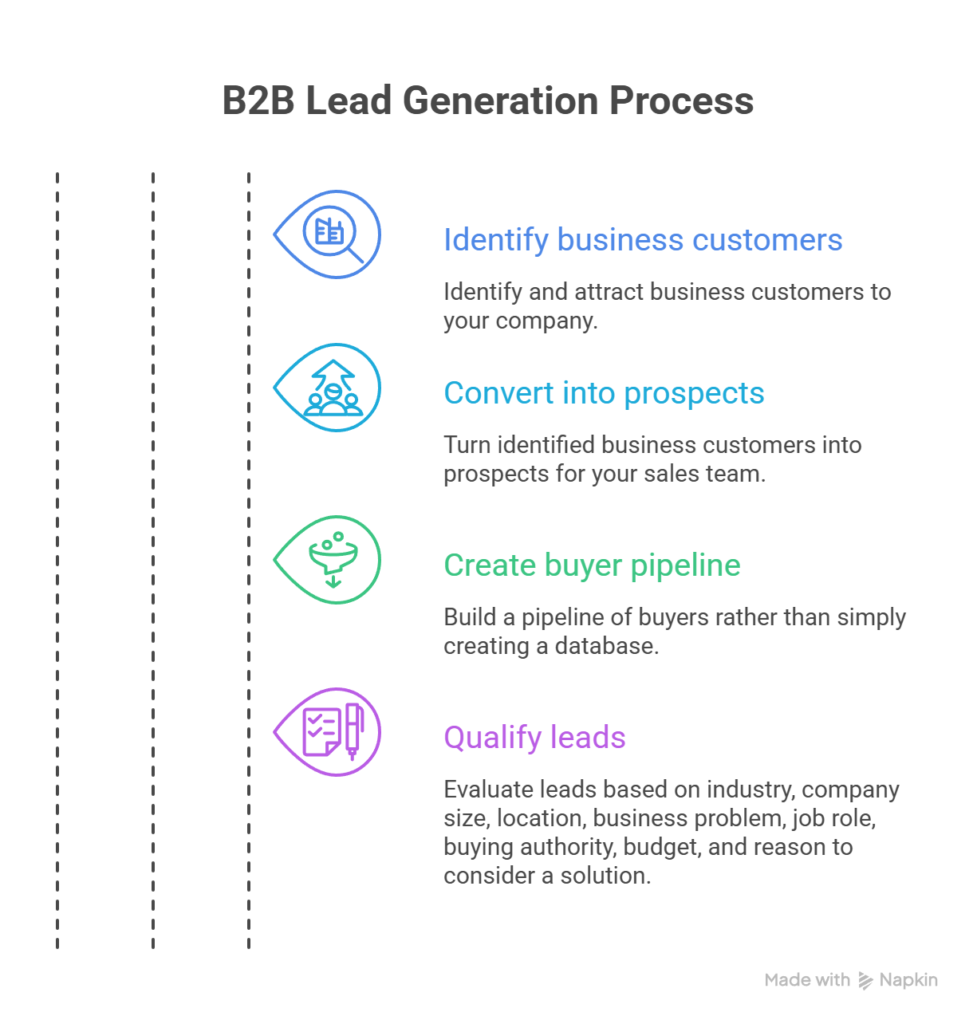
A B2B lead is a person or company that could potentially become a customer.
Not every lead has the same value.
For example imagine you sell enterprise software to companies with than 500 employees. Someone from a five person company downloading your ebook may technically be a lead. They may not be a useful prospect for your sales team.
This is why lead quality matters than lead volume.
A useful B2B lead usually has some combination of:
The industry
The right company size
The right location
A relevant business problem
A suitable job role
Buying authority or influence
Budget
A reason to consider a solution
The closer a lead is to your Ideal Customer Profile, the more valuable that lead becomes.
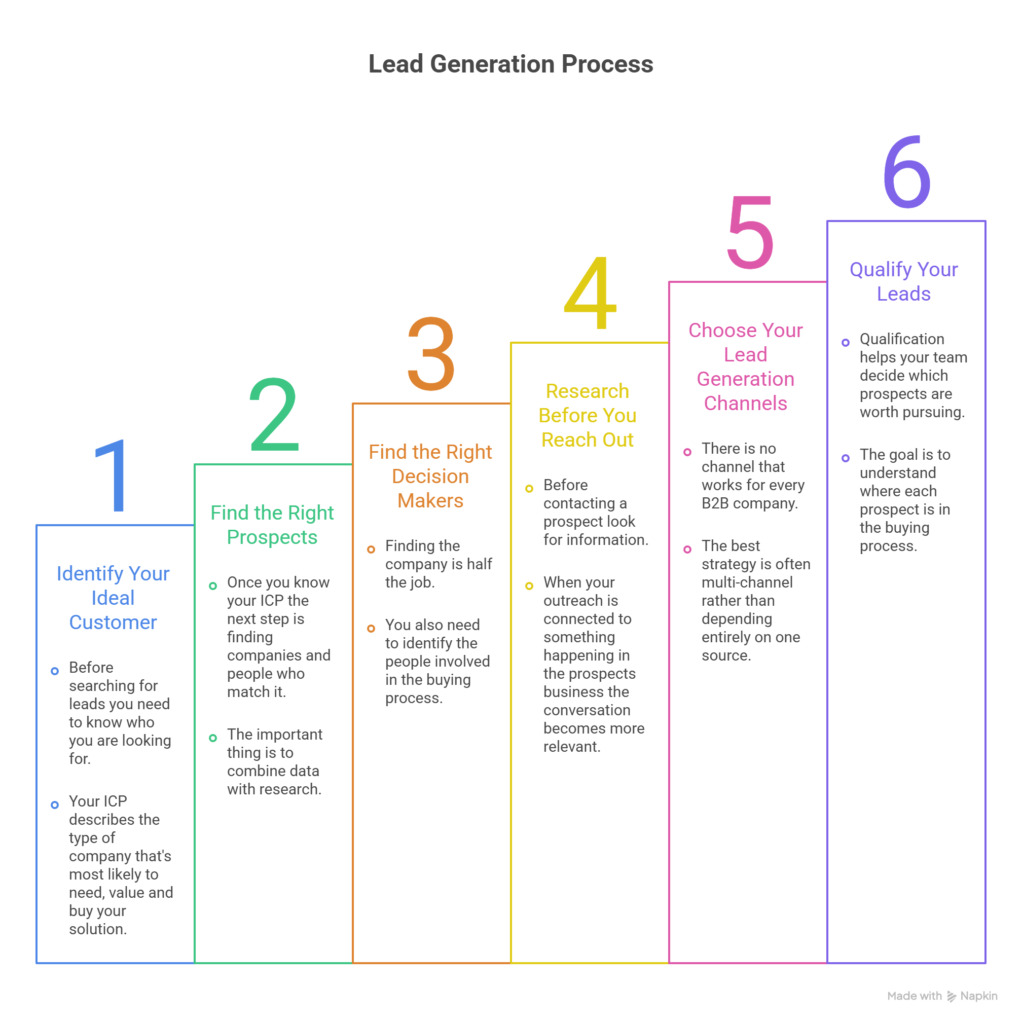
A simple B2B lead generation process looks like this:
Identify → Find → Engage → Qualify → Nurture → Convert
Lets look at each stage.
Before searching for leads you need to know who you are looking for.
This is where your Ideal Customer Profile or ICP comes in.
Your ICP describes the type of company that’s most likely to need, value and buy your solution.
You might define your ICP using:
Industry
Revenue
Employee count
Geography
Business model
Growth stage
Technology
challenges
Buying triggers
For example:
B2B SaaS companies in the US with 50 to 250 employees that are growing quickly and struggling with engineering capacity.
That is more useful than saying:
“We target technology companies.”
Without an ICP your sales team can spend hours contacting companies that were never a fit.
Good lead generation starts with knowing who not to target.
Once you know your ICP the next step is finding companies and people who match it.
Common sources include:
LinkedIn can help you identify companies, decision makers, job changes, company growth and relevant business activity.
B2B Data Platforms
Platforms such as Apollo, Lusha and similar databases can help sales teams find company and contact information.
Company Websites
A companys website can tell you about its products, customers, leadership team, industries and priorities.
Industry Directories
Industry specific directories can help you identify companies within a market.
Referrals
Existing customers, partners and professional networks can introduce you to buyers.
The important thing is to combine data with research.
A list of 5,000 contacts is not useful if only 100 actually fit your ICP.
Finding the company is half the job.
You also need to identify the people involved in the buying process.
Depending on what you’re selling that could be:
CEO
Founder
CTO
CFO
CIO
VP Sales
Head of Marketing
Procurement
Operations Director
Do not automatically assume that the ranking person is always the buyer.
In B2B purchases several people can influence the decision.
Your job is to understand who has the problem, who influences the decision and who ultimately approves the purchase.
This is where many lead generation campaigns go wrong.
Companies collect a list. Immediately start sending the same message to everyone.
That is not really prospecting.
It is simply outreach.
Before contacting a prospect look for information.
For example:
Are they hiring?
Did they recently raise funding?
Are they expanding into markets?
Did they launch a product?
Are they changing leadership?
Are they investing in technology?
Did they announce a business challenge?
These can be buying signals.
When your outreach is connected to something happening in the prospects business the conversation becomes more relevant.
There is no channel that works for every B2B company.
Your approach should depend on your ICP, industry, deal size, sales cycle and buying behaviour.
Common B2B lead generation channels include:
LinkedIn: Prospecting, relationship building thought leadership and direct outreach
Cold Email: Reaching targeted accounts at scale when the messaging and data are
Cold Calling: Creating direct conversations particularly when combined with research and other touchpoints
Content Marketing: Blogs, guides, case studies, newsletters and educational content
Events and Networking: Creating conversations with prospects, partners and potential customers
Referrals: Turning existing customer relationships into business opportunities
Paid Advertising: Reaching specific audiences when the offer and targeting are well defined
The best strategy is often multi-channel rather than depending entirely on one source.
Not every lead deserves the amount of sales attention.
Qualification helps your team decide which prospects are worth pursuing.
You might ask:
Do they have the problem?
If they don’t have the problem you solve there is reason to continue.
Do they have urgency?
A prospect can have a problem. Still have no reason to solve it now.
Are they the company?
Does the account actually fit your ICP?
Are you speaking with the person?
Is the person involved in the buying decision?
Do they have the resources to buy?
Depending on your solution, budget or available resources may be a factor.
The goal is not to reject every prospect that doesn’t meet every criterion.
The goal is to understand where each prospect is in the buying process.
These terms are often used interchangeably. They are not exactly the same.
Lead Generation
Lead generation focuses on identifying people or companies that could become sales opportunities.
For example:
Filling out a form
Booking a consultation
Responding to an email
Connecting with a salesperson
Downloading a resource
Demand Generation
Demand generation focuses on creating awareness and interest in your problem and solution.
For example:
Educational content
Thought leadership
Webinars
Industry research
Social media
Events
Brand campaigns
A simple way to think about it is:
Demand generation creates interest.
Lead generation develops that interest into sales opportunities.
Strong B2B growth usually needs both.
B2B lead generation sounds simple until you actually start doing it.
There are challenges.
Long Sales Cycles
B2B purchases can take weeks or months because multiple people may need to evaluate and approve the purchase.
Multiple Decision Makers
The person who discovers your company may not be the person who signs the contract.
Poor Data
Outdated emails, incorrect job titles and inaccurate company information can waste sales time.
Weak Positioning
If prospects don’t understand why your solution matters even a targeted campaign can fail.
Poor Follow Up
Many opportunities disappear simply because companies stop following up early.
Good lead generation requires more than a database.
It requires a system.
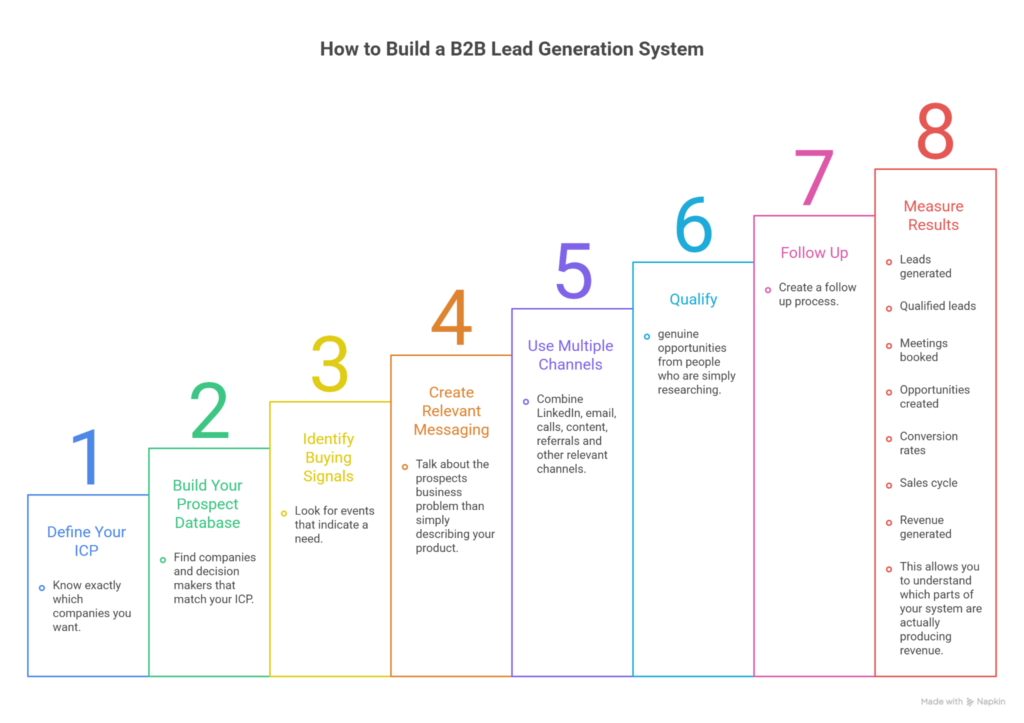
If you want results create a repeatable process.
Know exactly which companies you want.
Find companies and decision makers that match your ICP.
Look for events that indicate a need.
Talk about the prospects business problem than simply describing your product.
Combine LinkedIn, email, calls, content, referrals and other relevant channels.
genuine opportunities from people who are simply researching.
Create a follow up process.
Track:
Leads generated
Qualified leads
Meetings booked
Opportunities created
Conversion rates
Sales cycle
Revenue generated
This allows you to understand which parts of your system are actually producing revenue.
The biggest mistake is thinking:
“We need more leads.”
Sometimes that’s true.
Often the real problem is somewhere else.
You may have:
The wrong ICP
The prospects
The wrong messaging
The wrong channel
Poor qualification
Weak follow up
If you add more leads, to a broken process you simply create more work.
The goal should not be to get the leads.
The goal should be to generate qualified sales opportunities.
B2B lead generation isn’t about sending thousands of emails or gathering many contacts as possible.
It’s about finding the companies reaching the right people understanding their problems starting conversations that matter and building a process that moves qualified prospects closer to a buying decision.
The best B2B companies don’t see lead generation as a one time event.
They see it as a system they build and repeat.
When your ICP, positioning, prospecting, outreach, qualification and follow up all work together lead generation becomes more predictable.
At Salesamore we help B2B companies build client acquisition systems that find the prospects create qualified conversations and build a predictable sales pipeline.
If you are generating leads. Not turning them into meetings and revenue book a call with Salesamore.
We’ll help you find the gaps in your lead generation and sales process and show you where you can improve.
Book your call, with Salesamore. Start building a B2B sales pipeline.
To get valuable free insights deliver straight to your inbox
As an entrepreneur, I have gained great exposure to B2B sales strategies, processes, and practices as CEO of Salesamore. I am known for a strict approach and do not deviate from my target, which is to get my sales figures up by means of lead generation, demand generation, and Account-Based Marketing (ABM).
Through the deep understanding of Go-To-Market (GTM) strategies, I have been branded by the corporate sector as the one who turns opportunities into reality and the one who brings magic to the whole process.
I am thrilled to help startups polish their sales methods and smash the competition with unprecedented results. We hope you enjoyed reading this blog!
Don’t forget to check out these valuable resources to stay connected and explore more about what we have to offer:
Subscribe to My YouTube Channel: Stay updated with the latest videos, tutorials, and insights by subscribing to our YouTube channel.
Visit Our Website: Learn more about our services, solutions, and how we can help you achieve your goals by visiting our official website.
Watch Our Featured Video (VSL): Don’t miss our featured video! Click here to watch and gain valuable insights.
In accordance with the current EU data protection laws, please take a minute to reviwe the term & conditions for using our services. Our terms describe how we use data and the options available to you.

