B2B sales get harder as the deal size gets bigger.
There are people involved, the time it takes to close a deal is longer, people from the procurement department get involved, and when a customer says they are interested, it does not mean they are ready to buy.
This is when sales qualification frameworks help.
One of the frameworks used for complex B2B sales is MEDDICC. It helps sales teams know if an opportunity is real, what is making the purchase happen, who is in charge of the decision and what could stop the deal from being closed.
MEDDICC is not something every B2B company needs from the very beginning.
The real question is: When should you use MEDDICC, and how can you use it without making your sales process feel like a list of things to check off?
Let’s look at it.
MEDDICC is a way to check if a deal is worth pursuing in B2B sales.
The letters stand for:
Each part helps answer a question about the deal.
The goal is not just to collect information from the customer. The goal is to understand how the buying decision really works.
A customer might have a problem but still not become a customer. MEDDICC helps sales teams find out what is missing before they spend a lot of time on a deal.
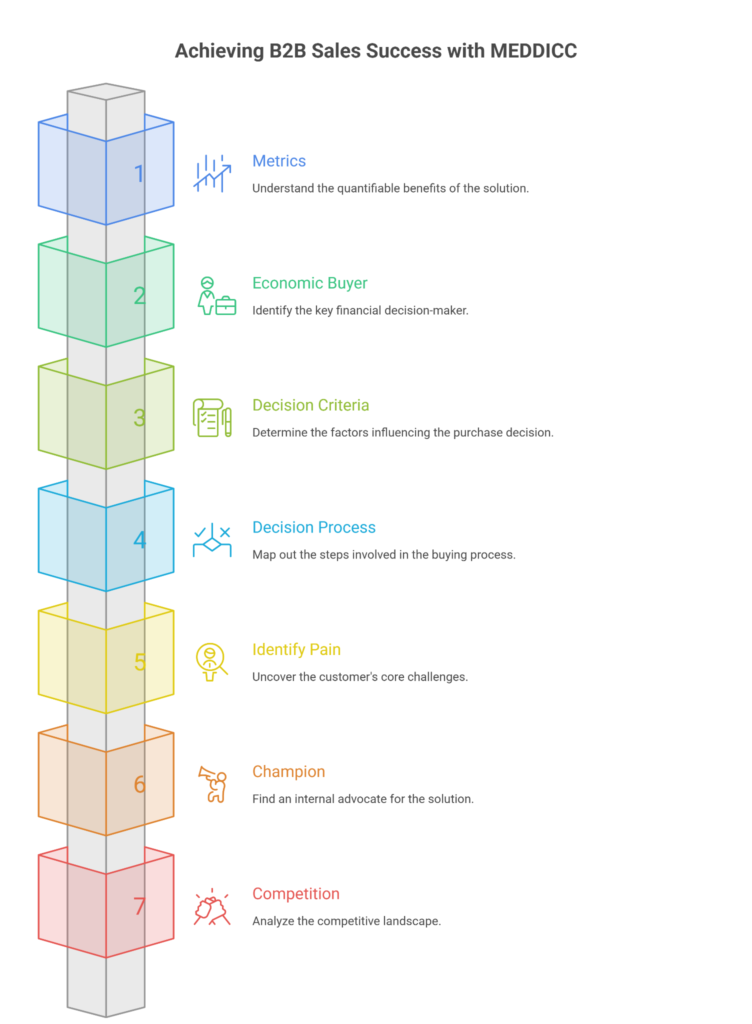
Metrics answer a question:
What real change will your solution make?
For example, saying:
Our platform can automate your reporting.
A better conversation would look into whether automation could save 30 hours of work each month, cut errors or help leaders make decisions.
The change makes it easier to show the value of your solution.
The economic buyer is the person who decides how the money is spent.
This is not always the person using your product.
A manager might like your solution. The person with the budget is the one who makes the final choice.
Knowing who the economic buyer is helps sales teams understand if they are talking to the right person.
Every customer has things they look for when making a decision.
These can include:
Price, features, security, how it works with tools, how long it takes to set up, how good the company is, if it follows rules and how helpful support is.
The key is to find out which of these things are most important to the customer.
If you don’t know what matters, you might focus on the wrong things.
Just because a company wants your solution doesn’t mean it will happen.
You need to know how the company actually makes a decision.
Who looks at the options?
Who approves?
Does the purchasing team get involved?
Is there a security check?
Does the board need to say yes?
What happens after the offer is made?
These details show the path from interest to buying.
This is more than finding out if the customer has a problem.
You need to understand the problem enough to see:
Why is this a problem now?
For example, “our sales process is not stable” is an issue.
Knowing that this issue causes missed money, too much help from referrals and pressure on the sales team gives the problem real meaning.
Pain becomes urgent when it affects business results.
A champion is someone in the customer’s company who believes in your solution and helps you move the deal forward.
They can give you details, introduce you to people,e explain how the decision is made and help with concerns.
A friendly person is not always a champion.
A real champion has influence and a reason to see the deal happen.
Competition is not other companies.
Your biggest competition could be:
Doing nothing.
It could also be an existing system, another provider, or just keeping things the same.
Understanding what the customer is comparing you to helps you show how your solution fits the decision.
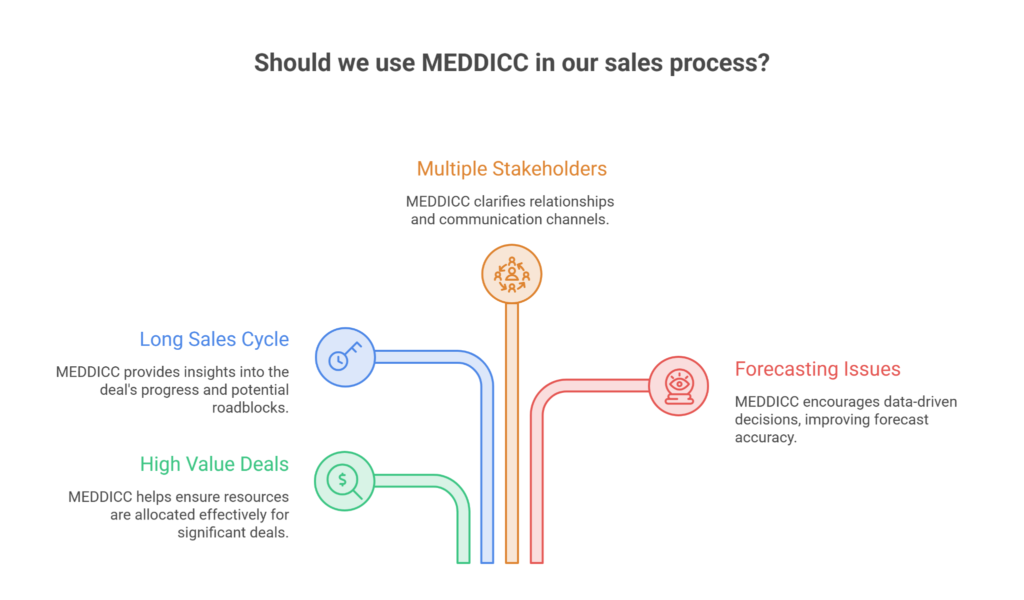
MEDDICC is especially helpful when your sales process has these traits.
Your Deals Are High Value
If one single deal makes a difference in your cash flow, spending time checking if it is worth pursuing makes sense.
The cost of chasing a deal is higher when the deal takes a long time, and many people are involved.
Your Sales Cycle Is Long
If it takes months to close a deal, your team needs to know what is really going on inside the company.
MEDDICC can help find out what is missing before the deal gets far.
Multiple People Are Involved
Big B2B deals seldom involve one person.
Marketing, IT, finance, operations, procurement and leaders may all play a role.
MEDDICC gives your team a way to understand these relationships.
Your Team Is Struggling With Forecasting
If deals seem to be going and then suddenly disappear, the problem is not always with your closing skills.
The deal may never have been properly checked.
MEDDICC encourages salespeople to look at the facts behind the deal,l not just hope.
MEDDICC is not needed for every sales team.
If you sell a product with a short time to close and one person in charge, using a seven-part process for every deal could make things harder.
The process should match the deal.
For B2B deals, a lighter process might be enough.
For deals with many people involved, MEDDICC can give the structure needed to understand what is really happening.
This is an important point.
MEDDICC should not become:
“I filled in all seven parts, so this must be an opportunity.”
Salespeople can fill out a form without understanding the deal.
The real value comes from the conversation behind the information.
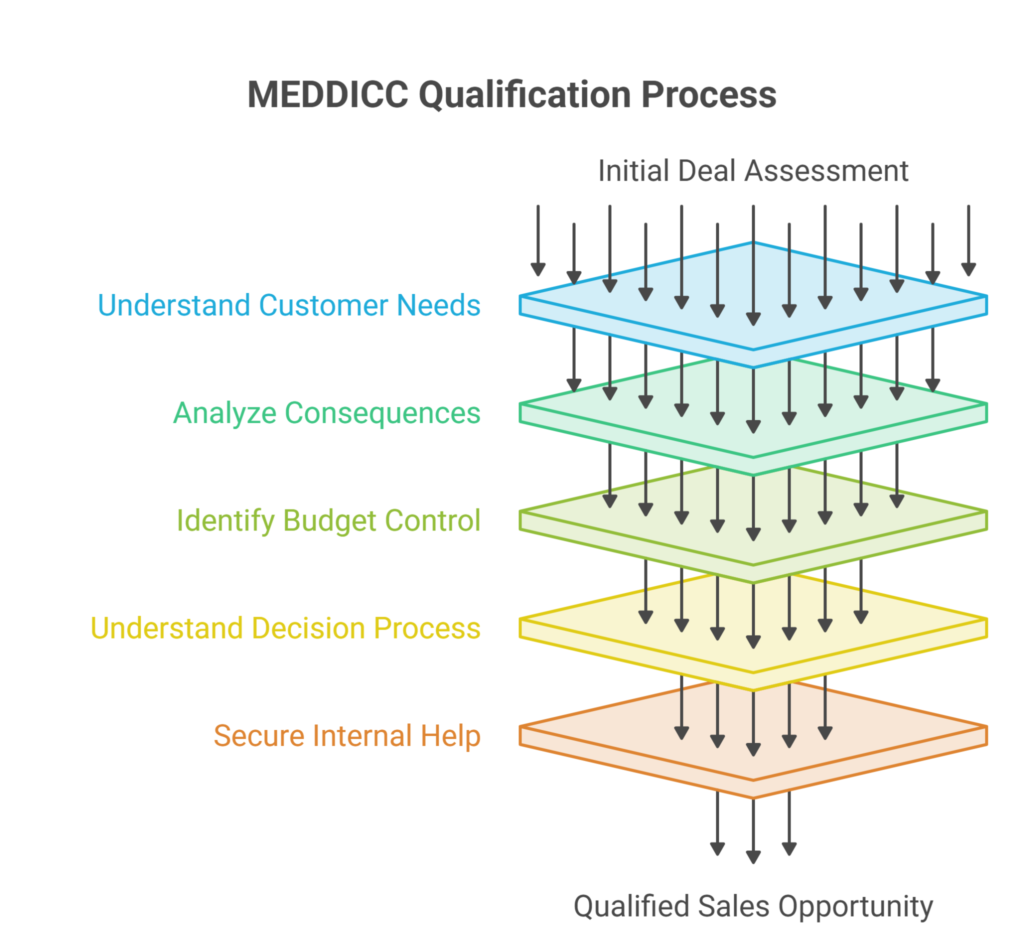
Do we know what the customer wants to achieve?
Do we know what happens if they do nothing?
Do we know who controls the budget?
Do we understand how the decision will be made?
Do we have someone inside the company helping us?
These answers are more important than checking boxes.
At Salesamore, qualification is not about making a lot of calls and labelling them as opportunities.
The main goal is to find the customer, research the company, understand the situation, start the right conversations and move qualified people toward real sales opportunities.
MEDDICC can help when the deal is complicated and needs checking.
The framework is not the plan.
It is a way to help your team ask questions and make better choices about where to spend time.
The biggest mistake in B2B sales is not losing a deal.
It is spending months on a deal that was never properly checked in place.
MEDDICC helps sales teams look beyond interest and understand the real reasons for buying, the people involved, how the decision is made, the support inside the company and what the competition is doing.
If your B2B sales process has deals, long times to close, and many people involved, it might be worth checking if your current way of checking deals is enough.
Want to improve how you find and turn B2B deals into business?
Comment “SALES”. Send a message with “SALES” and let’s start a conversation.
Book a call with Salesamore to talk about your current sales process, your pipeline and your customer growth challenges.
To get valuable free insights deliver straight to your inbox


As an entrepreneur, I have gained great exposure to B2B sales strategies, processes, and practices as CEO of Salesamore. I am known for a strict approach and do not deviate from my target, which is to get my sales figures up by means of lead generation, demand generation, and Account-Based Marketing (ABM).
Through the deep understanding of Go-To-Market (GTM) strategies, I have been branded by the corporate sector as the one who turns opportunities into reality and the one who brings magic to the whole process.
I am thrilled to help startups polish their sales methods and smash the competition with unprecedented results. We hope you enjoyed reading this blog!
Don’t forget to check out these valuable resources to stay connected and explore more about what we have to offer:
Subscribe to My YouTube Channel: Stay updated with the latest videos, tutorials, and insights by subscribing to our YouTube channel.
Visit Our Website: Learn more about our services, solutions, and how we can help you achieve your goals by visiting our official website.
Watch Our Featured Video (VSL): Don’t miss our featured video! Click here to watch and gain valuable insights.
In accordance with the current EU data protection laws, please take a minute to reviwe the term & conditions for using our services. Our terms describe how we use data and the options available to you.

