Let me start with something many sales leaders quietly experience.
You open your CRM and the pipeline looks strong. There are plenty of opportunities sitting across stages. Discovery calls done, proposals shared, follow-ups happening.
On paper, everything looks healthy.
But when the month ends, the revenue doesn’t match the activity. The deals that looked close are still “in progress.” Some have gone silent. Others keep moving to the next month.
And suddenly a question appears in every sales meeting:
This is a situation many sales teams face. The pipeline appears busy, but the money moves slower than expected.
The reason usually isn’t a lack of effort. It’s usually something deeper inside the pipeline itself.
Many teams measure pipeline health by volume.
More opportunities.
More meetings.
More companies added to the CRM.
It feels productive.
But a large pipeline does not automatically mean strong opportunities.
Sometimes the pipeline is full because leads were added too early in the process. A person downloaded a guide, attended a webinar, or responded to an email. That interaction gets converted into an opportunity.
But curiosity is not the same as buying intent.
A real opportunity usually has three things.
A clear problem to solve.
Someone who has authority to decide.
A realistic timeline for action.
If these elements are missing, the opportunity often stays in the pipeline for months without moving forward.
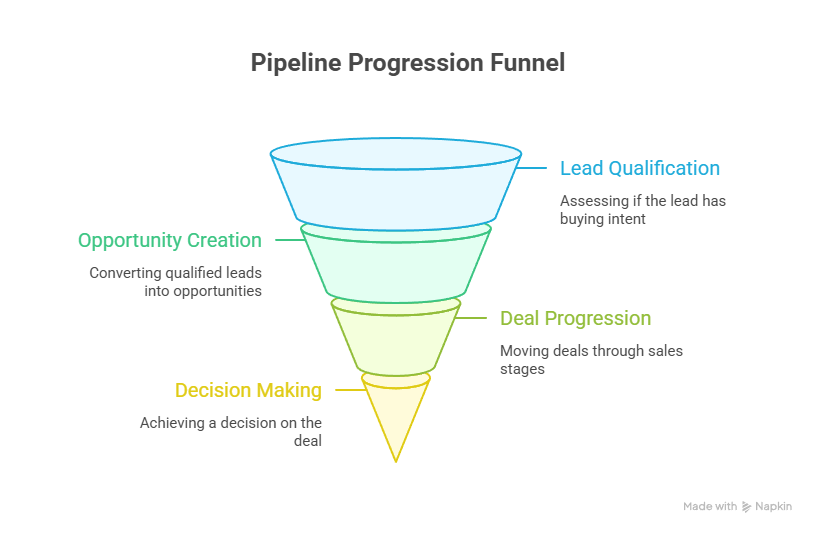
Another thing that slows revenue is when deals stop progressing.
They stay alive in the CRM, but nothing meaningful is happening.
You may see deals sitting in stages like:
Discovery completed
Proposal sent
Follow-up scheduled
But weeks pass without a real step forward.
The conversation continues, but the decision doesn’t move.
Over time the pipeline becomes crowded with deals that technically exist but are not actively progressing. They take space, create optimistic forecasts, and give the impression that business is coming soon.
In reality, those deals are simply waiting.
This is a very common situation.
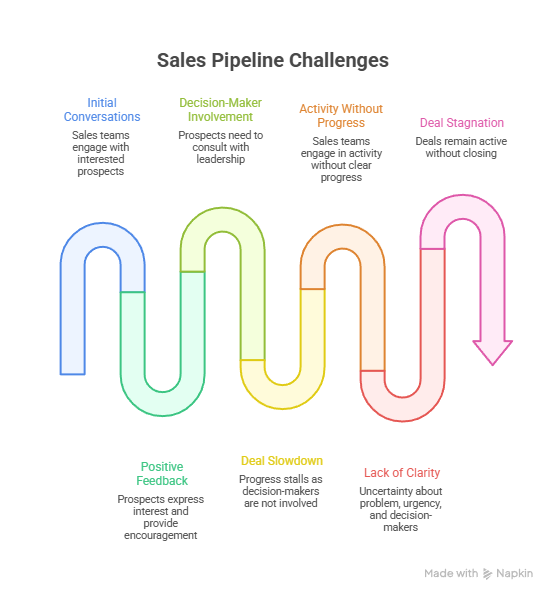
Sales teams spend weeks speaking with people who are interested in the solution. The conversations are positive. Demos are scheduled. Feedback sounds encouraging.
But when the discussion reaches the stage of commitment, the response changes.
“I need to speak with my leadership.”
“We have to review this internally.”
“Let me involve my manager.”
What seemed like progress suddenly slows down.
The problem is not the product. The problem is access.
When the real decision-makers are not involved early in the conversation, deals naturally take longer to close.
Sales teams often work extremely hard.
Calls are made every day. Emails are sent. Meetings happen constantly.
But activity alone does not guarantee progress.
A deal only moves forward when clarity improves.
Does the buyer clearly understand the problem?
Is there urgency to solve it now?
Are the decision-makers part of the conversation?
Is there a timeline for making a decision?
If these answers remain unclear, the deal may stay active for months without closing.
From the outside it looks like momentum.
Inside the deal, nothing is really changing.
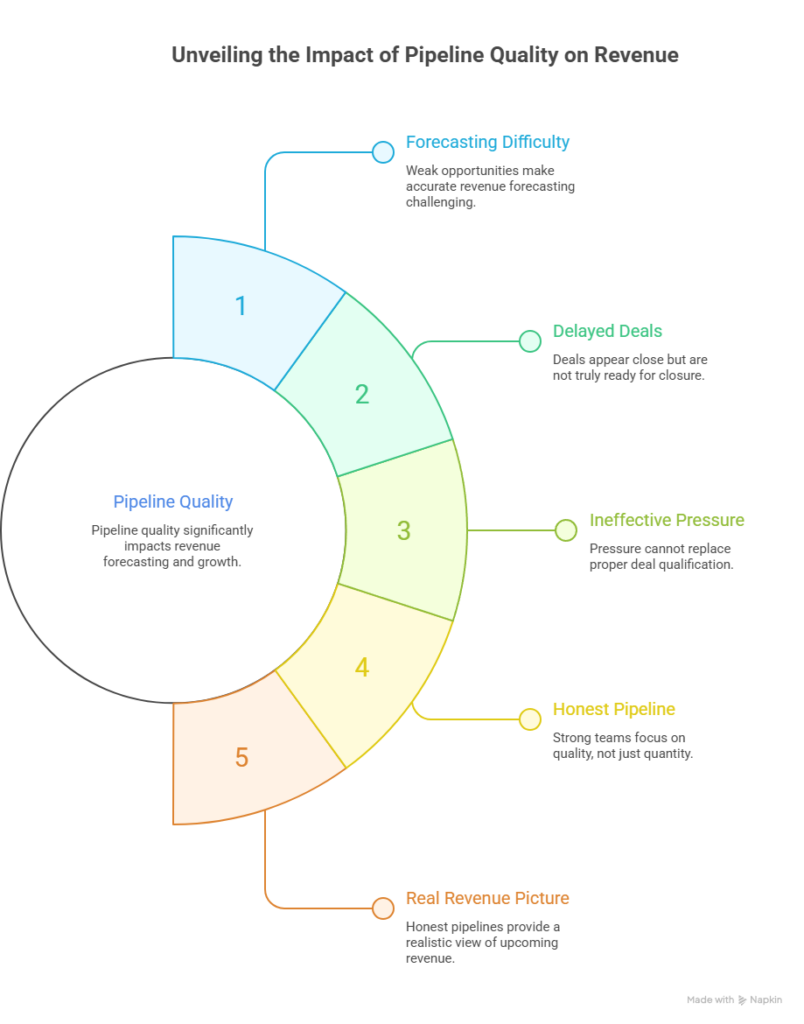
When the pipeline contains too many weak opportunities, forecasting becomes difficult.
Deals appear close but are not truly ready. Sales leaders expect revenue to arrive, but the deals quietly slip into the next month or quarter.
The team pushes harder. More follow-ups. More reminders.
But pressure cannot replace qualification.
Eventually the pipeline still looks full, but the revenue continues to move slowly.
The most effective sales teams don’t chase the biggest pipeline.
They focus on building the right pipeline.
Instead of asking “How many deals do we have?” they ask better questions.
Is this a real problem the company wants to solve?
Are we speaking with someone who can influence the decision?
Is there a clear timeline?
Is the next step defined?
If an opportunity does not meet these conditions, it is either re-qualified or removed from the pipeline.
This keeps the pipeline honest and allows leaders to see the real picture of upcoming revenue.
Having a full pipeline can be very reassuring, but at the same time it can also mislead you into thinking that you are making progress when really you are not.
For instance, if you put opportunities in the pipeline too early, if deals are left in the same stages for long, or if discussions are held with people who have no decision-making power, it is very likely that revenue will always seem slower than what you expected.
Simply pumping the pipeline is not the aim.
Rather, you should be crafting a pipeline such that each and every opportunity is leading towards a proper decision.
Consequently, the pipeline might shrink, but you will have a lot greater certainty about the amount of revenue you will generate.
Besides, selling teams do not waste their time on those deals that were never ready to be pursued in the first place.
If your pipeline looks full but revenue still feels slow, there may be hidden gaps in your sales process.
Sometimes the issue is qualification. Sometimes it is access to decision-makers. Sometimes the deal simply entered the pipeline too early.
Comment DOCTOR if you want a free consultation and guidance from Sales Doctor Geevee.
Book a free consultation with Salesamore
https://salesamore.com/consultation
To get valuable free insights deliver straight to your inbox




As an entrepreneur, I have gained great exposure to B2B sales strategies, processes, and practices as CEO of Salesamore. I am known for a strict approach and do not deviate from my target, which is to get my sales figures up by means of lead generation, demand generation, and Account-Based Marketing (ABM).
Through the deep understanding of Go-To-Market (GTM) strategies, I have been branded by the corporate sector as the one who turns opportunities into reality and the one who brings magic to the whole process.
I am thrilled to help startups polish their sales methods and smash the competition with unprecedented results. We hope you enjoyed reading this blog!
Don’t forget to check out these valuable resources to stay connected and explore more about what we have to offer:
Subscribe to My YouTube Channel: Stay updated with the latest videos, tutorials, and insights by subscribing to our YouTube channel.
Visit Our Website: Learn more about our services, solutions, and how we can help you achieve your goals by visiting our official website.
Watch Our Featured Video (VSL): Don’t miss our featured video! Click here to watch and gain valuable insights.
In accordance with the current EU data protection laws, please take a minute to reviwe the term & conditions for using our services. Our terms describe how we use data and the options available to you.

